A) can be determined for main sequence stars but not for other types of stars
B) are greatest in the lower left and least in the upper right
C) decrease from upper left to lower right
D) are impossible to determine
F) A) and B)
Correct Answer

verified
Correct Answer
verified
A) By measuring the masses and spectral types of main-sequence stars in binary systems
B) By using computer models of hydrogen fusion and stellar structure
C) By measuring stellar radii with very powerful telescopes
D) By comparing stars with the same spectral type but different luminosities
F) A) and C)
Correct Answer
verified
Correct Answer
verified
B) False
Correct Answer
verified
Correct Answer
verified
A) visual binary
B) eclipsing binary
C) spectroscopic binary
D) double star
E) none of the above
G) C) and D)
Correct Answer
verified
Correct Answer
verified
B) False
Correct Answer
verified
Correct Answer
verified
A) upper right
B) lower right
C) upper left
D) lower left
F) All of the above
Correct Answer
verified
Correct Answer
verified
B) False
Correct Answer
verified
Correct Answer
verified
Correct Answer
verified
Tom is on the main sequence, while Jerry...View Answer
Correct Answer
verified
View Answer
Correct Answer

Answered by ExamLex AI
Astronomers overcome the limitation of n...View Answer
Correct Answer
Answered by ExamLex AI
View Answer
B) False
Correct Answer
verified
Correct Answer
verified
A) The remains of a star that ran out of fuel for nuclear fusion
B) A main sequence star of spectral type F, which tends to look white in color
C) It is a type of star that produces energy by gravitational contraction.
D) It is a star that follows a period-luminosity relation.
F) None of the above
Correct Answer
verified
Correct Answer
verified
A) A yellow star
B) A red star
C) A blue star
E) A) and B)
Correct Answer
verified
Correct Answer
verified
A) a
B) b
C) c
D) d
E) e
G) D) and E)
Correct Answer
verified
Correct Answer
verified
A) location where they are formed
B) time they are formed
C) luminosity they are formed with
D) mass they are formed with
E) color they are formed with
G) C) and D)
Correct Answer
verified
Correct Answer
verified
A) It is the spectral type of the hottest main sequence star in a star cluster, and it tells us the cluster's age.
B) It is the point in a star cluster beyond which main sequence stars are not found, and it tells us the cluster's distance.
C) It is the luminosity class of the largest star in a star cluster, and it tells us the cluster's age.
D) It is the mass of the most massive star in the star cluster, and it tells us the cluster's size.
F) A) and C)
Correct Answer
verified
Correct Answer
verified
A) Three quarters hydrogen, one quarter helium, no more than 2% heavier elements
B) Half hydrogen and half helium
C) 98% hydrogen, 2% helium
D) 95% hydrogen, 4% helium, no more than 1% heavier elements
F) All of the above
Correct Answer
verified
Correct Answer
verified
A) Watts
B) Joules
C) Newtons
D) Watts per second
E) Watts per square meter
G) A) and D)
Correct Answer
verified
Correct Answer
verified
A) 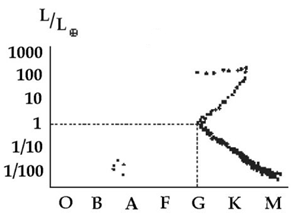
B) 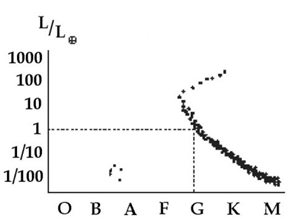
C) 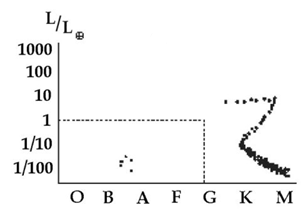
D) 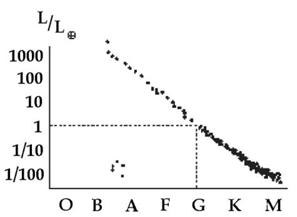
F) All of the above
Correct Answer
verified
Correct Answer
verified
B) False
Correct Answer
verified
Correct Answer
verified
A) apparent brightness of the star in our sky.
B) surface temperature of the star.
C) lifetime of the star.
D) total amount of energy that the star will radiate over its entire lifetime.
E) total amount of energy that the star radiates each second.
G) A) and E)
Correct Answer
verified
Correct Answer
verified
Showing 41 - 60 of 129
Related Exams